
Discover a wide range of professional anti-slip solutions for industry, construction and offshore, such as anti-slip tape, slip protection for stairs, slip-resistant rung covers, anti-slip safety footwear, slip-resistant floor plates, gratings, anti-slip floor paints/coatings or anti-slip strips, needed in various industries, especially where slippery surfaces can pose a safety risk. Our slip-resistant products are needed in various industries, such as the food industry and the oil, gas and chemical industries, especially where slippery surfaces can pose a safety risk.
Why are anti-slip solutions important?
“One in five accidents at work is a slip, trip or fall. This makes it the second most common cause of all occupational accidents. … 176,575 people suffered an occupational accident in 2015 as a result of slipping, tripping or falling.” (Source: German Social Accident Insurance (DGUV) – Fact Sheet: Slips, trips and falls)
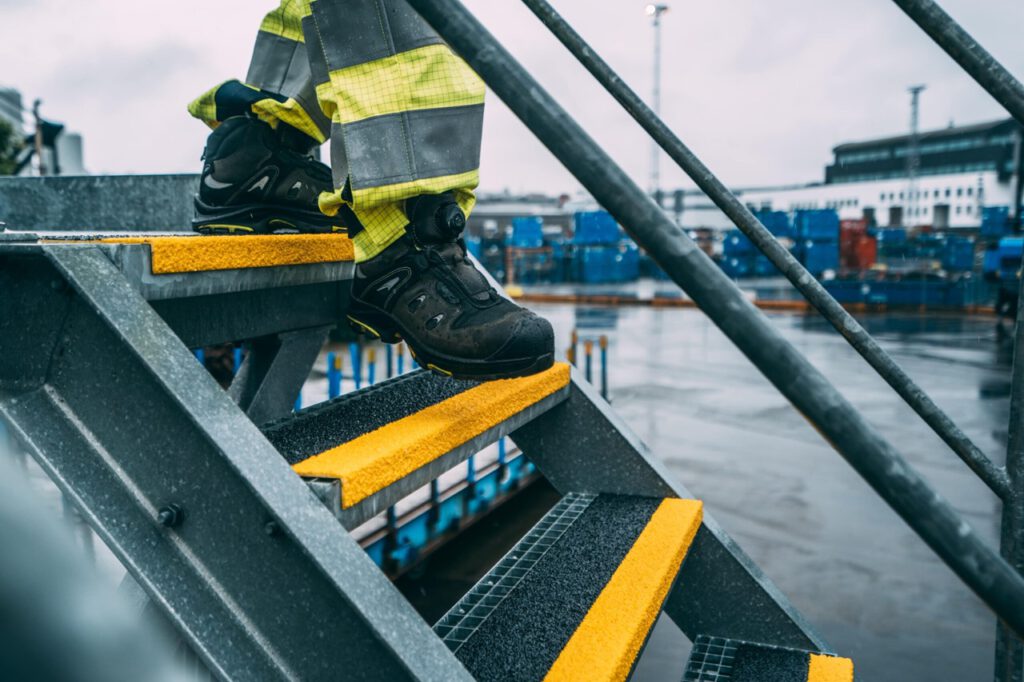
Our anti-slip solutions are either self-adhesive or screw-fixed, are durable and hard-wearing, and help prevent slips and falls, e.g. on stair treads, especially on stairs or wet surfaces. Suitable for indoor, outdoor and wet areas or as warning tape.
Where are anti-slip solutions typically used?
Here are some typical industries in which anti-slip solutions are particularly important:
- Food industry: In production facilities, warehouses and cold rooms where liquids such as water, oils and food waste can be spilled.
- Logisticsand warehousing industry: In warehouses, freezer stores, on loading platforms, ramps and in areas where pallets and goods are moved, to prevent falls and accidents.
- Healthcare: In hospitals, care facilities and medical laboratories, to prevent slips on floors that are often contaminated with water, disinfectants and other liquids.
- Retail: In supermarkets, shopping centres and shops, to protect customers from falls on slippery floors, especially in areas such as fruit and vegetable departments where food can be spilled.
- Shipbuilding and shipping: On ships, boats and port facilities, to reduce the risk of falls on wet decks or in bad weather.
- Sports and leisure industry: In swimming pools, gyms, sports stadiums and leisure facilities, to prevent accidents on slippery surfaces, especially where water is present.
- Construction industry: On construction sites, stairs, scaffolding and temporary walkways, to protect construction workers from falls and injuries, especially in bad weather or muddy conditions.
- Chemical industry: In production plants, laboratories and warehouses where hazardous chemicals can be spilled, to prevent occupational accidents and ensure employee safety.
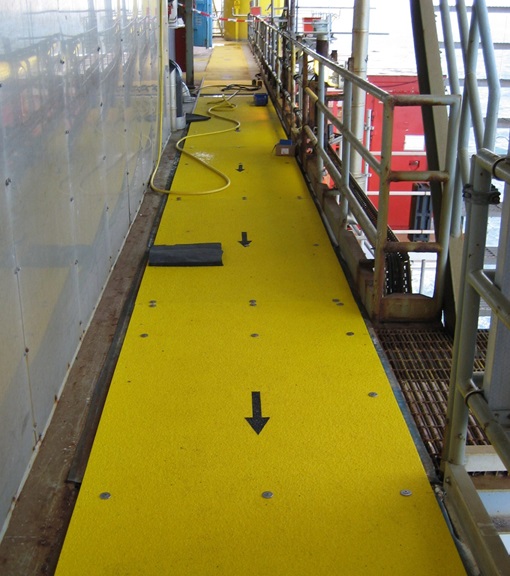
- Oil and gas industry / offshore: On drilling rigs, production platforms and other offshore installations, where marine conditions and oil or chemical spills can lead to extremely slippery surfaces.
- Wind energy industry: On wind turbines, wind power plants and in wind farms, where maintenance work is carried out at great heights and slippery conditions can arise from moisture, rain or ice.
What slip resistance classes are there?
Slip resistance classes are a classification of floor coverings based on their slip resistance properties. They are used to assess the slip hazard of floor surfaces and to ensure safety in different environments. The classes range from R9 to R13, with R9 having the lowest slip resistance and R13 the highest. “The rating serves as a measure of the degree of slip resistance, with floor coverings rated R 9 meeting the lowest and those rated R 13 the highest slip resistance requirements.” (Source:DGUV Rule 108-003 (formerly BGR 181, German Social Accident Insurance rules, now withdrawn – ASR A1.5, the German Technical Rule for Workplaces on floors, is now authoritative) – Floors in work rooms and work areas with slip hazards) The slip resistance classes for floor coverings are standardised in German standard DIN 51130 .
“Slip accidents are largely influenced by the material and surface texture of the floor covering and by the degree of contamination. Unsuitable footwear or soles, incorrect floor cleaning, inappropriate walking speed and objects lying around particularly increase the risk of tripping.” (Source: BGN industry knowledge, Accident-proof design of floors, Occupational Safety Information (ASI) 4.40)
Here is a brief description of the Slip resistance classes:
- R9: This corresponds to low slip resistance and is suitable for low-risk areas such as dry areas.
- R10: This class offers medium slip resistance and is suitable for areas of moderate risk such as bathrooms or changing rooms.
- R11: Slip resistance is increased, suitable for higher-risk areas such as kitchens or wet areas.
- R12: This class offers enhanced slip resistance and is suitable for high-risk areas such as commercial kitchens or uncovered ramps. Barefoot areas, e.g. in swimming pools, are assessed separately according to classes A, B and C.
- R13: This is the class with the highest slip resistance and is recommended for extremely high-risk areas such as industrial kitchens or food processing areas.
Extract – WITHOUT GUARANTEE!
| Work rooms, work areas and internal traffic routes | Slip hazard rating (R group) | ||
| General work rooms and areas | |||
| Entrance areas, indoors | R9 | ||
| Entrance areas, outdoors | R11 or R10 | ||
| Stairs, indoors | R9 | ||
| Outdoor stairs | R11 or R10 | ||
| Toilets | R9 | ||
| Changing and washrooms | R10 | ||
| Break rooms (e.g. staff rooms, works canteens) | R9 | ||
| First-aid rooms | R9 | ||
| Production of margarine, edible fats, edible oils | R 13 (R12) | ||
| Milk processing, cheese making | R 12 (R11) | ||
| Chocolate and | R12 | ||
| confectionery production | R 12 (R11) | ||
| Production of baked goods (bakeries, patisseries, long-life bakery products) | R 12 (R11) | ||
| Kitchens, dining rooms | R 12 (R 10) | ||
| Slaughtering, meat processing | R13 | ||
| Fish processing, delicatessen production | R13 | ||
| Laundry | R 9 / R 11 | ||
| Metalworking and processing, metal workshops | R11 | ||
| Wastewater treatment plants | R12 | ||
| Cold rooms, freezer rooms, cold stores, freezer stores | R 12 (R11) |
It is important to choose the right slip resistance class for the specific environment and regulations in order to prevent accidents and injuries: DGUV Rule 108-003 (now withdrawn; ASR A1.5 is authoritative): Floors in work rooms and work areas with slip hazards.
Frequently asked questions about anti-slip solutions
What slip resistance does my work area need?
That depends on how it is used. Annex 2 of ASR A1.5 assigns slip resistance ratings from R9 to R13 to work areas, in some cases supplemented by a displacement volume (V4 to V10). This classification is a guide. Your risk assessment remains decisive.
Can existing floors and stairs be retrofitted to make them non-slip?
Yes, in many cases. Depending on the substrate, anti-slip strips, tapes, GRP sheets, stair nosings, mats or coatings can be used. Replacing the floor covering is then often unnecessary.
Are there versions for wet, outdoor and chemical areas?
Many products are available in versions for wet conditions, weather, oil or chemicals. We only confirm properties such as R13, chemical resistance or fire behaviour for versions with corresponding test certificates, which you can receive on request.
How does an enquiry work?
Send us photos, dimensions and a brief description of the conditions of use via the contact form. We will then suggest suitable versions.
Related solutions and industries
- Slip resistance R9 to R13 and standards clearly explained
- Retrofitting industrial floors to make them non-slip
- Retrofitting industrial stairs to make them non-slip
- Anti-slip solutions for the food industry
- Anti-slip solutions in the Rhine-Main area
Further information: DGUV Information 208-041: Assessment of slip hazards under operating conditions