
Ladders can be very slippery, especially when the rungs, your shoes or your hands come into contact with water, frost, snow, grease, oil or other slippery substances. Reduce the risk of accidents on ladders with our slip-resistant rung covers, also known as ladder rung treads or ladder rung caps – simple to retrofit!
Ladder rung covers offer a range of safety and comfort benefits, especially on fixed access ladders such as those on radio masts. Here are the key benefits:
Anti-slip protection for ladders – simply retrofit slip-resistant ladder rung covers!
✅ Slip protection – Our ladder rung covers are made of very robust, highly slip-resistant GRP material (R13), which stops shoes and hands from slipping. The perfect solution for maximum sure-footedness.
✅ Injury prevention – Sharp-edged rungs can be “defused” with our covers.
✅ Better visibility – Eye-catching yellow improves visibility and reduces the risk of accidents, even in poor visibility conditions.
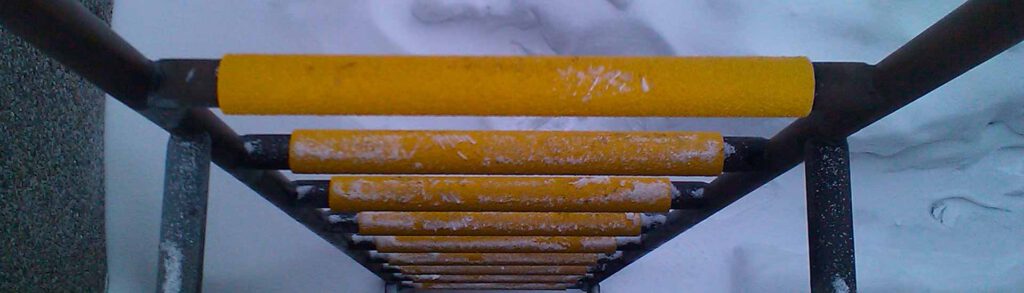
Working on fixed access ladders carries an increased risk depending on the height – which can lead to serious injury or even death. It is therefore essential to make ladders safe, and our slip-resistant ladder covers are designed to prevent slips and falls.
The anti-slip ladder rung treads are made of high-quality glass fibre with embedded aluminium oxide grit. This makes them virtually indestructible and highly slip-resistant (R13).
Important legal notice: The information given here on standards, dimensions, retrofit options and safety requirements is provided to the best of our knowledge, but without guarantee of completeness or legal validity. Actual requirements may vary depending on the area of use, the year the ladder was built, applicable standards, the company’s risk assessment and official regulations. The operator or employer is solely responsible for safe use as well as for professional installation and regular inspection. In case of doubt, we recommend consulting the individual regulations and standards, an occupational safety specialist and, where applicable, the relevant German statutory accident insurance institution (Berufsgenossenschaft).
Applications for slip-resistant ladder rung covers
- Chemical, petrochemical and process plants: Safe climbing on ladders exposed to oil, acids or solvents.
- Food industry: Hygienic anti-slip solution for wet areas and cleaning zones.
- Municipal facilities: Swimming pools, pumping stations and maintenance shafts.
- Water supply & wastewater treatment plants: Corrosion-free retrofit in damp conditions and permanently wet clarifier tanks.
- Energy & wind power plants: Slip-resistant rungs on masts, towers and maintenance ladders for power supply installations and transmission lines.
- Construction & scaffolding companies: Temporary and permanent safety solution for installation ladders.
- Shipbuilding, port operations and offshore installations: Saltwater-resistant anti-slip covers for access ladders and deck ladders in marine environments.
- Access ladders in warehouses, silos, tanks & vessels: Non-slip footing where dust, moisture and gases are present.
- Mechanical and plant engineering: Retrofitting of maintenance ladders and inspection access points.
- Agriculture & agricultural engineering: Ladders on silos, livestock buildings or conveyor systems exposed to mud or moisture.
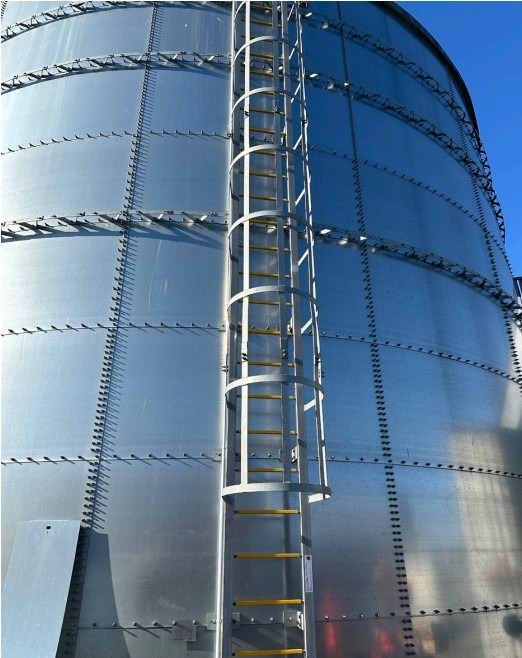
(Image source: Höhentechnik FÖRSTER Safetysolutions GmbH, Panroder Str. 24, 65510 Hünstetten, www.hoehentechnik-foerster.de – used with kind permission.)
Available sizes of ladder rung covers
Only ladder rungs with a diameter or width of at least 20 mm BEFORE retrofitting may be fitted with the GRP ladder rung covers!
Shape: square

Channel width x length in mm
- 20 mm x 300 mm, 20 mm x 400 mm, 20 mm x 500 mm, 20 mm x length made to measure
- 25 mm x 300 mm, 25 mm x 400 mm, 25 mm x 500 mm, 25 mm x length made to measure
- 30 mm x 300 mm, 30 mm x 400 mm, 30 mm x 500 mm, 30 mm x length made to measure
- 35 mm x 300 mm, 35 mm x 400 mm, 35 mm x 500 mm, 35 mm x length made to measure
- 38 mm x 300 mm, 38 mm x 400 mm, 38 mm x 500 mm, 38 mm x length made to measure
Shape: round

Diameter x length in mm
- Ø20 mm x 300 mm, Ø20 mm x 400 mm, Ø20 mm x 500 mm, Ø20 mm x length made to measure
- Ø25 mm x 300 mm, Ø25 mm x 400 mm, Ø25 mm x 500 mm, Ø25 mm x length made to measure
- Ø30 mm x 300 mm, Ø30 mm x 400 mm, Ø30 mm x 500 mm, Ø30 mm x length made to measure
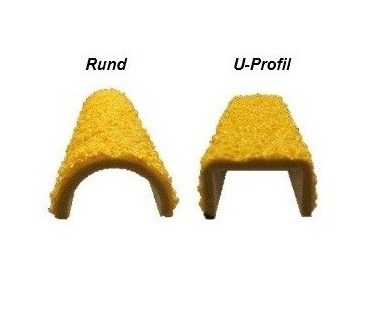
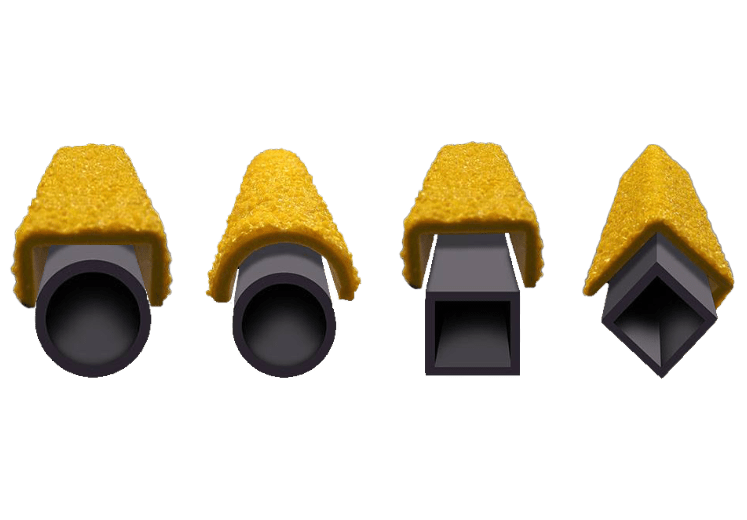
Since the 2019 revision of German standard DIN 18799 Part 1, round rungs on fixed ladders are classed as a safety issue. The square ladder rung covers can be fitted not only to square rungs but also to the round rungs of fixed ladders. They then form a slip-resistant, rectangular GRP rung profile (slip resistance R13) in accordance with DIN 18799-1.
Installation instructions for anti-slip ladder rung covers
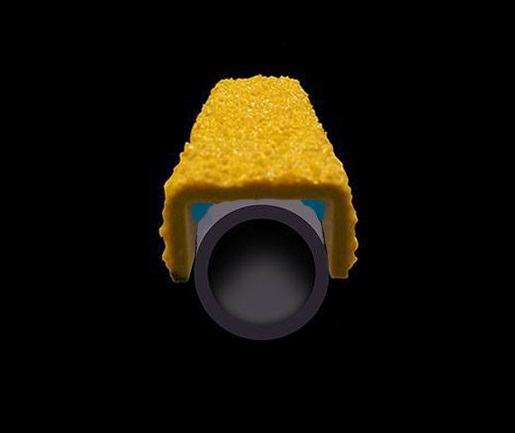
Our highly slip-resistant rung covers made of solid GRP fit directly over existing (round or rectangular) ladder rungs and can cover all standard rungs (round or square). Using additional adhesive in the cavities, it is also possible to retrofit a square ladder rung cover onto a round rung (with a sufficiently large tread width of at least 20 mm diameter), see the following example image:
“Sure-footedness
DGUV Information 208-032: Selection and use of fixed access ladders (German Social Accident Insurance)
Fixed access ladders must provide secure footing. In addition to the dimensions, this includes sufficient slip resistance of the rung tread surface, the design of which depends on the operating conditions.
The tread depth of the rung must be at least 20 mm.”
– Tread width of square rungs: min. 20 mm
– Round rungs should, however, be avoided as they offer only low slip resistance (rung diameter min. 25 mm)
BG RCI: Practical handbook for the building materials industry, A 3.4 Fixed access ladders
Our rung covers for secure footing are typically used in marine, offshore, industrial and commercial environments where ladders provide access to elevated areas. The benefits include:
- Reduced risk of slips and falls: The slip-resistant surface provides excellent grip – even when the ladder is wet or oily – allowing workers to climb up and down safely.
- Improved ladder safety: Installing our ladder rung covers significantly reduces the risk of slips and falls.
- Compliance with safety standards: Installing our covers can help ensure that safety standards and regulations are met – reducing the risk of penalties or legal liability for non-compliance. See, for example, VBG: Fixed access ladders and step-iron ladders (and further links)
- Fewer workplace accidents and lower injury costs: By reducing the risk of slips and falls, our ladder rung covers lower accident-related costs.
In addition, the covers also protect the ladder rungs from wear, extend the service life of the ladder and reduce maintenance costs.
Another way to increase sure-footedness on ladders even further is our special ladder safety shoes with “Ladder-Grip” integrated into the sole.
Invest in the safety of your ladders with our anti-slip ladder rung covers and ensure safe climbing up and down on every rung.
FAQ – Ladder rung covers / ladder rung treads / retrofit anti-slip rung caps
Question 1: What are ladder rung covers or ladder rung treads, and what are they used for?
Ladder rung covers – also known as ladder rung treads or anti-slip rung caps – are slip-resistant retrofit covers for existing ladder rungs (usually made of steel). They instantly make ladders safer underfoot, improve grip in wet, oily or dirty conditions or in winter frost, and reduce the risk of slips and falls. They are used in almost all industrial and maintenance areas.
Question 2: What are the benefits of ladder rung treads?
Ladder rung treads increase sure-footedness and slip resistance (R13), create a grippy anti-slip surface and, thanks to their yellow colour, make the rungs more visible. They also protect the original rung, extend its service life and help meet company safety standards. The likelihood of accidents drops significantly, especially in critical environments involving moisture, chemicals or fluctuating outdoor temperatures.
Question 3: What materials are these covers made of?
Our high-quality ladder rung treads are made of glass-reinforced plastic (GRP) with integrated slip-resistant hard grit particles such as silicon carbide or aluminium oxide. This combination of materials ensures a permanently sure-footed, abrasion-resistant and corrosion-resistant surface – ideal for industrial, offshore and aggressive environments.
Question 4: Which rung shapes do the covers fit?
The covers can be used on rectangular and square rungs and – with filler material – also on round rungs. For optimum sure-footedness, a minimum tread width of approx. 20 mm is recommended. Many models are universally retrofittable and suitable for fixed access ladders as well as portable ladders.
Question 5: How are ladder rung treads installed?
The installation of the non-slip ladder rung covers is quick and easy:
- Clean the rung
- Place the ladder rung tread on or around the rung
- if necessary, fill cavities with adhesive or mounting paste
- Check the fit
Retrofitting can usually be done without special tools and, once the adhesive has cured, makes the ladder safe underfoot.
Question 6: Which standards and safety requirements apply?
What matters are high slip resistance values (e.g. R13-rated surfaces), robust material quality and compliance with general safety regulations for fixed access ladders, maintenance access points and technical installations. Ladder rung treads are an effective way to meet safety standards and support risk assessments.
Question 7: In which industries are ladder rung treads used?
Areas of use include:
- Chemical and petrochemical industry
- Food and beverage industry
- Water and wastewater management
- Energy and wind power technology
- Masts (e.g. power, wind power, mobile communications, etc.)
- Construction, trades, scaffolding
- Offshore, marine and port facilities
- Industrial plants, servicing, maintenance
- Agriculture, conveyor and silo technology
- Municipal facilities and technical services
These covers are used wherever ladders need to be made safer underfoot.
Question 8: Can existing ladders be retrofitted?
Yes. Ladder rung treads are a fast and cost-effective retrofit solution. They can be fitted to almost any intact rung and turn existing ladders into a significantly sure-footed and safer solution for work.
Question 9: Which colours are available and why does it matter?
We supply the retrofit rung covers in highly visible yellow.
Question 10: How long do slip-resistant ladder rung treads last?
GRP-based models are extremely durable, UV-resistant, chemical-resistant and virtually maintenance-free. Even with intensive or daily use, their slip-resistant properties are retained for many years.
Question 11: What criteria are important when choosing?
For maximum sure-footedness, the following points should be considered:
- Slip resistance of the surface (very coarse anti-slip grit)
- Material quality (GRP, slip-resistant particles)
- Fit for the rung shape and width
- Visibility and warning effect
- Resistance to moisture, chemicals and UV
- Ease of installation and freedom from maintenance
- Durability
Question 12: What needs to be considered during planning and installation?
The rungs must be intact, the cover must match the rung shape, and the mounting surface should be clean and dry. After installation, a firm fit is essential to ensure long-term, sure-footed use. In safety-critical areas, the installation should be documented and inspected regularly. The manufacturer’s instructions must always be followed!
Question 13: Is it permitted to retrofit ladders?
For retrofits to existing ladders (portable ladders, fixed access ladders, maintenance ladders in industrial plants), special rulesapply that differ somewhat from those for new builds or the recertification of ladders.
Here is a practical, standards-compliant summaryof how retrofits are assessed:
✅ 1. Principle: retrofitting is permitted – but only if it improves safety
Retrofits such as ladder rung treads, anti-slip profiles or rung covers are permissible, because they increase safety and significantly reduce the risk of slipping.
For operators, the key factor is the risk assessment – not necessarily a full recertification of the ladder.
✅ 2. Minimum dimensions apply BEFORE retrofitting
For existing ladders, especially older industrial ladders, the following is crucial:
◾ The tread width or diameter of the rung must be at least approx. 20 mm BEFORE retrofitting
This is the minimum size used in many technical rules for a safe tread width (rectangular) or an equivalent surface.
✅ 3. Round rungs on existing fixed ladders
Standards (e.g. DIN 18799-1) no longer permit round rungs for new fixed access ladders.
However:
The square ladder rung covers can be fitted not only to square rungs but also to the round rungs of fixed ladders. They then form a slip-resistant, rectangular GRP rung profile (slip resistance R13) in accordance with DIN 18799-1.
✔ … provided the operator demonstrates in the risk assessment
that the retrofit ensures secure footing (e.g. by means of covers).
➡️ In practice:
A slip-resistant rung cover is accepted as a recognised safety measure.
✅ 4. What needs to be considered when retrofitting?
◾ The rung must be structurally intact and have a minimum diameter or width of 20 mm BEFORE conversion
Dents, cracks or corrosion → have them professionally repaired or replace the rung first.
◾ The cover must have sufficient load-bearing capacity
GRP rung covers generally meet this requirement.
◾ Installation must be full-surface and in accordance with the manufacturer’s instructions
e.g. using adhesive or mounting compound. We can supply these on request.
◾ Documentation recommended
A brief note is sufficient:
e.g. “Existing ladder – retrofit to improve slip resistance – risk assessment updated.”
✅ 5. Does an existing ladder have to be recertified after retrofitting?
No.
A retrofit is a maintenance measure; whether it is permissible in an individual case must be checked in advance.
Whether the retrofit requires approval from the ladder manufacturer, a new inspection or further measures depends on the type of ladder, the rung geometry, the fixing method and the relevant standards. Clarify this in advance with a competent person as part of your risk assessment and observe the manufacturer’s information.
In addition:
However:
The employer remains responsible for the annual ladder inspection (DGUV) and for the safety of the ladder.
✅ 6. Typical retrofit situations
✔ old industrial fixed access ladders with round steel rungs
✔ access to silos, shafts, pumping stations
✔ wind power and energy technology
✔ ladders in chemical, water and food processing plants
✔ Outdoor stairs/fixed access ladders that become slippery in winter
In all these cases, rung covers are accepted as a safe improvement.
Matching products
A selection from our range. We will be happy to provide sizes, versions, prices and delivery times on request.
GRP ladder rung cover PolyGrip
Item no. DD-GRP-5000600-R-M-25
GRP rung cover with corundum grit for round or square ladder rungs. Length and diameter can be adapted.
- Round or square, diameter 20 to 35 mm
- Choice of grit and colour
Related solutions and industries
- Securing fixed access ladders in wind turbines
- Ladders in wastewater treatment plants and waterworks
- Anti-slip solutions for chemical plants
- Slip protection for offshore and shipbuilding
- Custom-made moulded rung parts
- Truck roof de-icing system with non-slip working platform
Further information: DGUV Information 208-016: The use of ladders and steps (PDF)

⭐ Conclusion:
Retrofitting existing ladders with slip-resistant ladder rung covers is permitted and worthwhile (provided the tread is ≥ 20 mm BEFORE installation), as it significantly increases the sure-footedness of the ladder.
Please note the “important notice” above in orange text and the manufacturer’s instructions!