
Stairs are among the most common accident locations in businesses. Worn steps, wet gratings and poorly visible edges quickly lead to missteps. If you want to make industrial stairs non-slip, retrofitting the existing steps is often the quickest and most cost-effective solution.
We offer products that are fitted to existing steps: GRP stair tread covers, stair nosings, anti-slip strips and coatings. This secures the tread and the step edge without having to replace the stairs. Depending on the type of step, the environment and the load, we combine the products to suit your stairs.
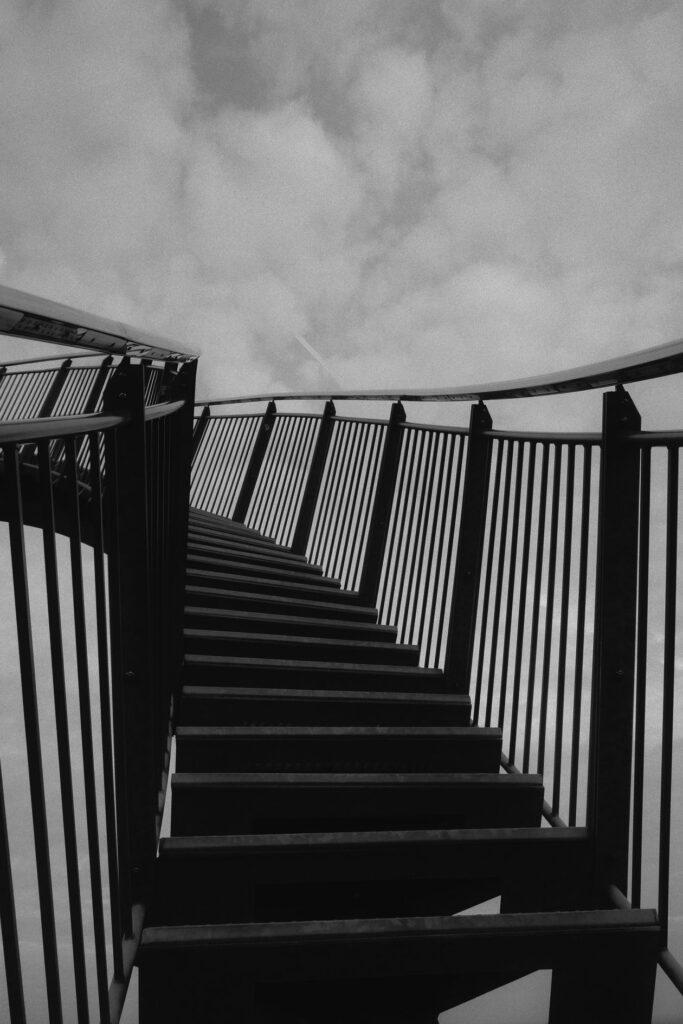
Typical hazard areas on industrial stairs
- Steel grating stairs with smooth or worn steps
- Chequer plate steps in wet or oily conditions
- Metal stairs outdoors in rain, leaves and ice
- Poorly visible step edges, especially in low light
- First and last steps, where attention often lapses
- Missing or slippery grip on the handrail
Suitable solutions for making industrial stairs non-slip
GRP stair tread covers for industrial stairs
GRP stair tread covers with a gritted surface are screwed or bonded onto existing steps. The yellow nosing makes the step clearly visible. For outdoor stairs, you will find details on our page on stair tread covers. We manufacture non-standard step sizes as custom-made products.
Retrofitting steel grating stairs to make them non-slip
Grating steps can be covered with anti-slip sheets or stair tread covers. Alternatively, the steps can be replaced with slip-resistant gratings. Which option fits depends on mesh size, condition and load.
Stair nosings
The step edge is a particularly critical point when walking downstairs. This is where the foot lands first. Stair nosings secure the edge and mark it in a high-contrast colour. This also helps in poor lighting.
Anti-slip strips for quick retrofitting
Self-adhesive anti-slip strips are a simple solution for closed steps made of sheet metal, concrete or wood. They are bonded onto the cleaned tread. Under heavy loads, screw-fixed solutions are often more durable.
Coating for chequer plate steps
On chequer plate steps, an anti-slip coating for chequer plate increases the grip of the entire tread.
Handrail and winter maintenance
A secure grip is part of it. A handrail anti-slip cover improves grip in wet conditions. Advice on protection in snow and ice can be found under Winter safety for stairs and paths.
Selection: what matters
Slip resistance
ASR A1.5 (German Technical Rule for Workplaces on floors) and its Annex 2 provide guidance on the slip resistance ratings R9 to R13 for work areas. Testing is carried out according to DIN EN 16165:2023 (German edition of European standard EN 16165); older certificates sometimes still refer to German standard DIN 51130. For outdoor metal stairs and areas with oil, a high rating usually makes sense. Your risk assessment is decisive.
Substrate
Grating, chequer plate, concrete or wood require different products and fixings. Step width, tread depth and the shape of the front edge are also important. Check the condition, corrosion and load-bearing capacity of the steps before retrofitting.
Cleaning
Coarse surfaces grip well but trap dirt. Clarify how the stairs are cleaned. Versions with test certificates for chemical resistance are available on request.
Fixing
Screw fixing is usually the more robust choice for gratings and heavy loads. Bonding avoids drilling but needs a clean, dry surface. Make sure covers do not change the step height unevenly – steps of differing heights are themselves a trip hazard. Where possible, therefore, retrofit all steps in a flight uniformly.
How your enquiry works
- Describe the situation: You tell us about the affected surfaces, steps or rungs, the substrate and the ambient conditions. Photos and rough dimensions help with the initial assessment.
- Agree the solution: We suggest suitable products, versions and fixing methods, and clarify any test certificates required at the same time.
- Receive a quotation: You receive an individual quotation with dimensions, quantities and specifications. Then you can decide at your leisure.
Matching products
A selection from our range. We will be happy to provide sizes, versions, prices and delivery times on request.
GRP stair nosing PolyGrip Industrial Grade
Item no. DD-GRP-5000703-BK-IM
Robust GRP nosing profile for industrial and escape stairs, fitted onto existing steps. Non-conductive and maintenance-free, in standard lengths from 600 to 2400 mm.
- Profile 50 x 50 mm, various lengths
- Fine or medium grit
- Non-conductive, maintenance-free
GRP stair tread cover PolyGrip Industrial Grade
Item no. DD-GRP-5000412-IM
Black GRP stair tread cover with yellow warning nosing for industrial stairs and grating steps. Can be retrofitted, non-conductive and maintenance-free.
- Black with yellow nosing (RAL 9005/1023)
- Fine or medium grit
- Non-conductive
Frequently asked questions: making industrial stairs non-slip
How can I retrofit steel grating stairs to make them non-slip?
GRP stair tread covers or anti-slip sheets screwed onto the grating steps are common. Alternatively, you can replace the steps with slip-resistant gratings. We will clarify suitability based on dimensions and photos.
Are GRP stair tread covers for industrial stairs also suitable for oil?
The gritted surface provides grip even when contaminated. Whether a version is suitable for specific oils or chemicals depends on the product. Versions with corresponding test certificates are available on request.
How do I secure outdoor metal stairs?
Secure outdoor metal stairs with stair tread covers, stair nosings and a grippy handrail. In snow and ice, winter clearing and gritting are still necessary.
Do industrial stair treads need to be refurbished or is a retrofit enough?
As long as the steps are structurally sound, retrofitting the surface is often sufficient. If steps are deformed or heavily corroded, they should be replaced. You make the decision on the basis of your risk assessment.
Would you like to make industrial stairs non-slip or refurbish individual steps? Send us photos, dimensions and a brief description. Also tell us whether the stairs are indoors or outdoors and what contamination occurs. We will suggest a suitable solution for your stairs.