
Slip resistance classes, formats, surfaces and how to enquire. Around the clock.
How it works: from enquiry to delivery →Your input, photos and files are sent to Anthropic (Claude) and OpenAI (ChatGPT) in the USA to answer your question; according to the providers, API data is not used for training. Please do not enter personal or confidential data.Anti-slip stair nosing – also known as step edging or stair edge profiles – consists of prefabricated angle profiles that are bonded or screwed to the leading edge of a step. Each nosing does three jobs at once: it creates a permanently slip-resistant tread surface exactly where the foot lands, it marks the step edge in a high-contrast colour, and it protects the edge against mechanical wear. That makes it one of the most cost-effective ways to retrofit safety to existing indoor and outdoor stairs.
Terms & selection
Stair nosing, step edge profile, stair profile – what is what?
Many different terms are used in the trade for the same component. This overview helps you find the right profile for commercial stairs.
Stair nosing profile = step edge profile
Both refer to an angle profile on the front edge of the step. It provides slip resistance exactly where the foot lands and makes the edge visible.
Edge protection for stair treads
The profile protects damaged or worn step edges made of concrete, wood, stone or grating from further wear – without replacing the stairs.
Stair trim profile
A trim profile provides a visual finish for floor coverings such as vinyl or laminate. For workplaces with a risk of slipping, a gritted, slip-resistant nosing profile is the better choice.
Material: GRP, aluminium or stainless steel
GRP with corundum grit is corrosion-resistant, non-conductive and remains grippy when wet – ideal for industrial and outdoor use. Metal profiles are more common indoors where contamination is low.
Bonding or screw-fixing
On smooth, load-bearing substrates, bonding is often sufficient. For outdoor stairs, high loads or gratings, profiles are additionally screw-fixed.
For outdoor stairs
Complete outdoor step surfaces can also be covered with GRP step covers and step mats.
Further information: HSE – Slips and trips · HSE – Flooring
Anti-slip stair nosing: edge protection for stair treads indoors and outdoors
The step edge is the most dangerous point on any staircase: this is where the foot lands first when going down, where the surface is most worn, and where slips and trips are particularly common. An anti-slip stair nosing protects precisely this area. It combines three functions: a grippy tread surface, a clearly visible contrasting edge and lasting edge protection for stair treads.
GRP step edge profile
Our step edge profiles are made of glass-fibre reinforced plastic (GRP) with embedded corundum grit. The material does not rust, does not conduct electricity and is resistant to oil, many chemicals and UV light. The grit remains grippy even when wet, greasy or dirty. Through-coloured profiles retain their signal colour even after years of wear on the surface.
Clearly visible step edge
Yellow or contrasting profiles mark the front edge even in poor light. For accessible design, sufficient luminance contrast in accordance with DIN 32975 is decisive. Photoluminescent versions additionally aid orientation in the event of a power failure.
Stair nosing profile for outdoor use
Outdoor stairs are exposed to rain, leaves, frost and road salt. A stair nosing profile for outdoor use must therefore be weatherproof and must not become brittle in the cold. GRP meets these requirements and is suitable for concrete, stone, wood, steel and gratings. For complete step surfaces we also offer step covers and step mats.
Retrofitting without replacing the stairs
A stair nosing profile is bonded to the existing step and, depending on the substrate and load, additionally screw-fixed. This makes damaged or worn edges safe again without the stairs having to be renewed – saving costs and downtime in operations, warehouses or public buildings.
Selection and enquiry
The decisive factors are the substrate, step depth, contamination and use. Send us photos, dimensions and quantity via our enquiry form. We will propose suitable profiles and provide price and delivery time. We only confirm slip resistance classes for versions with test certification.
Why the step edge decides how safe a staircase is
Stair accidents rarely start in the middle of a tread. Two moments are critical: slipping on the way down, when only the front of the shoe is in contact with the step, and missing a step when the edge is not clearly visible. Both causes are located right at the nosing – and that is exactly where a stair edge profile takes effect.
When walking downstairs, a large share of body weight rests on a very small contact area at the edge.
Worn, polished or damp edges are the first to lose grip because they take the heaviest wear.
With uniform colouring, steps blur into one another – especially against the light, at dusk and for people with impaired vision.
Retrofit profiles improve grip and visibility in a single step, without structural changes to the stairs.
Construction and materials
A stair nosing profile consists of a base material and a slip-resistant surface. Together they determine load capacity, durability and where the nosing can be used.
Base materials
Glass-reinforced plastic (GRP)
corrosion-free, electrically non-conductive, UV- and weather-resistant and resistant to many chemicals. GRP stair nosing is the first choice for external stairs, industry, the water sector and marine environments.
Aluminium
lightweight, dimensionally stable and durable – typically with aluminium oxide inserts or a gritted coating. Proven in buildings with heavy footfall.
Stainless steel
for hygiene-sensitive areas and high mechanical loads, for example in food processing.
Rigid plastic and rubber
economical solutions for indoor stairs with moderate use, often with a flexible tread zone.
Slip-resistant surfaces
Mineral grit of aluminium oxide or silicon carbide for maximum grip under footwear.
Finer grit grades for areas that are mopped or where gloves and clothing come into contact with the surface.
Textured, grit-free surfaces for barefoot and wet areas.
Photoluminescent or reflective edge strips for poorly lit stairwells and escape routes.
Stair nosing types at a glance
Angle profile (L-shape)
covers both tread and riser at the edge. The classic choice for retrofitting, and edge protection at the same time.
Flat profile / tread edge strip
sits on the tread only, where the riser must remain clear or the build-up height is limited.
Profile with contrast edge
with a separate colour band, such as yellow on black, for maximum visual guidance – yellow stair nosing is the most common variant.
Grating nosing
specially shaped to be clamped or bolted onto open-grid steel treads.
Profile for timber stairs
with adapted screw spacing so that fixings do not split the wood.
Photoluminescent profile
with a long-afterglow strip for escape and evacuation routes.
Slip resistance, standards and marking
Selection depends on the requirement that applies at the place of use. Our products are classified to the following (mainly German and European) standards and regulations:
- DIN 51130 – ratings R9 to R13 for workrooms and work areas used with footwear. For external stairs, the German workplace regulation ASR A1.5 generally specifies R11, or R10 with displacement space V4. Where there is heavy soiling, oil or ice, the risk assessment may justify a higher rating.
- EN 16165 – test methods for slip resistance: Annex B (with footwear) for classes R9 to R13, Annex A for wet barefoot areas (A, B, C) such as swimming pools, showers and changing rooms. Formerly DIN 51130 and DIN 51097.
- ASR A1.5 – the German technical rule for workplaces covering floors and traffic routes, including the slip resistance of stairs.
- ASR A1.3 and DIN 4844 – German rules on safety signs, including yellow-and-black marking of hazard points.
- DIN 32975 – German standard on visual contrast for accessible design; relevant to the luminance contrast of step markings.
- DIN EN 16165:2023 – brings together the recognised test methods for determining slip resistance, including the ramp test and the pendulum tester.
Stairs must be designed so that they can be used safely. Treads must be slip-resistant, and the leading edges of steps must stand out clearly from the rest of the floor covering.
Typical applications
External stairs at offices, production and warehouse buildings exposed to rain, leaves, frost and de-icing salt
Steel and open-grid stairs on plant, silos, tanks, platforms and walkways
Escape stairwells and secondary stairs with poor lighting
Retail and public areas with heavy footfall
Stairs in food businesses, kitchens and wet areas
Residential and care settings where secure footing and clearly visible edges are particularly important
Agriculture and forestry, workshops and vehicle access steps
Fitting anti-slip stair nosing in five steps
Check the substrate
steps must be sound, level and free of loose material. Broken edges are filled beforehand.
Clean and degrease
remove dust, oil, moss and cleaning residues completely and let the surface dry thoroughly.
Measure and cut
profiles are cut to the width of the step; a small gap at the sides is recommended so that water can drain away.
Fix in place
bond with a suitable construction adhesive, screw with countersunk fixings, or combine both. Outdoors and under heavy use, mechanical fixing is preferable.
Press down and allow to cure
observe the adhesive’s application temperature and curing time, and keep the stairs out of use until full strength is reached.
An advantage over building works: retrofitting can be carried out section by section while the site stays operational – no need to close the whole stairwell, and no mess or drying times as with a coating.
Selection criteria – the key questions before you order
Indoors or outdoors, dry or permanently wet?
Are the stairs used with footwear or barefoot?
Which rating is required – R class or barefoot class?
What are the steps made of: concrete, steel, grating, timber, tiles?
How heavy is the footfall, and is there vehicle or trolley traffic?
Is there chemical exposure, for example from oils, cleaning agents or de-icing salt?
Is a contrast strip, a photoluminescent version or a particular colour required?
What build-up height is acceptable without creating a new trip hazard?
How stair nosing compares with other solutions
Stair nosing is one of several ways to make stairs safer. The right choice depends on the condition of the steps.
Anti-slip strips are the quickest and cheapest solution, as long as the steps themselves are intact and level.
Stair tread covers cover the entire tread and are suitable where the step surface is already damaged or worn.
Nosing profiles
sit in between: they secure the critical edge specifically, protect it from further wear and mark it at the same time.
Anti-slip floor coatings make sense where a seamless, full-surface solution is needed and the area can be closed off while the coating cures.
Cleaning and maintenance
Sweep regularly or rinse with water; otherwise coarse-grit surfaces trap dirt and lose grip.
Outdoors, remove leaves, moss and algae – a frequently underestimated cause of slips.
Check fixings once a year and retighten any loose screws.
Heavily worn individual profiles can be replaced without working on the whole staircase.
Check the contrast regularly: a clogged or faded marking no longer does its job.
Conclusion
Anti-slip stair nosing secures exactly the spot where most stair accidents begin. It combines slip resistance, visible edge marking and edge protection in a single component, can be retrofitted quickly while the building stays in use, and needs little maintenance for many years. For existing stairs, it is one of the most effective measures relative to the effort involved.
Matching products
A selection from our range. We are happy to provide sizes, versions, prices and lead times on request.
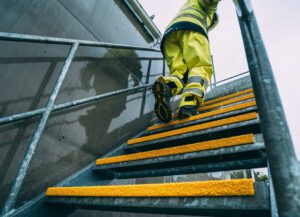
GRP stair nosing, yellow
Item no. DD-RS-KANTE-GELB
Slip-resistant GRP step edge whose yellow colour clearly marks the leading edge, even in poor light.
- Lengths 450–1200 mm, depth 75 mm
- Coarse or extra-coarse grit
- Corrosion-resistant, indoors and outdoors
- Minimum order quantity: 10 pieces
GRP stair nosing, black
Item no. DD-RS-KANTE-SCHWARZ
Black, slip-resistant GRP step edge for industrial, offshore and commercial stairs.
- Lengths 450–1200 mm, depth 75 mm
- Coarse grit
- For concrete, steel, timber and tiles
- Minimum order quantity: 10 pieces
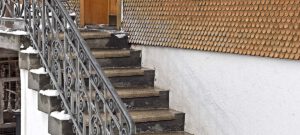
R13 stair tread mat
Item no. DD-AK-SICHERHEITSMATTE-TREPPE
Flat and angled stair tread mats made from R13 safety matting for outdoor and indoor stairs. Supplied ready to fit with edge protection or aluminium rail and adhesive tape.
- R13 / V10 (IFA)
- Fire class Bfl-s1
- Angled tread 30 × 73 cm, pack of 5
GRP stair nosing, colour-impregnated throughout
Item no. DD-GRPF-5000500-BK-M
GRP angle profile with embedded aluminium oxide grit for retrofitting stair edges on concrete, timber, stone or grating. Coloured throughout, so wear is barely visible.
- Through-coloured GRP, fine/medium grit
- Available made to measure
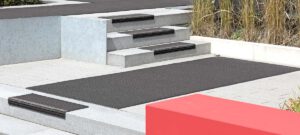
R13 angled stair tread mat with stone-effect finish
Item no. DD-AK-UNICO-WINKELSTUFE-30X73
Angled stair tread mat with a stone-effect finish for outdoor stairs. Improves footing, protects the steps from wear and spares the nosing thanks to the edge protection. Ready to lay with double-sided tape.
- R13 / V10 (IFA), fire class Bfl-s1
- 30 × 73 cm (25 cm deep + 5 cm angle), pack of 5
- Stone, Basalt, Graphite, Sand, Lava; −25 to +60 °C
GRP stair nosing for industrial stairs
Item no. DD-GRPF-5000703-BK-IM
Heavy-duty GRP nosing profile for industrial stairs, fitted over existing steps. Non-conductive and maintenance-free, in standard lengths from 600 to 2400 mm.
- Profile 50 × 50 mm, various lengths
- Fine or medium grit
- Non-conductive, maintenance-free
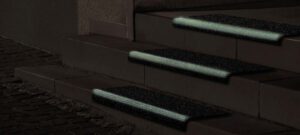
Photoluminescent angled stair tread mat
Item no. DD-AK-WINKELSTUFE-LUX
Slip-resistant angled stair tread mat with a photoluminescent surface that remains visible for up to eight hours, depending on light exposure. For cellar and outdoor stairs.
- Afterglow up to 8 hours
- Weather-resistant
- 30 × 73 cm, pack of 5
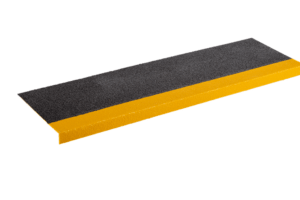
GRP stair tread cover with integrated nosing
Item no. DD-GRPF-5000400-YE-M
Full GRP stair tread cover with integrated nosing, for stairs in concrete, timber, tiles or grating. Lightweight, coloured throughout and designed for indoor and outdoor use.
- Size 1000 × 350 × 50 mm, also made to measure
- Colours black, grey, yellow
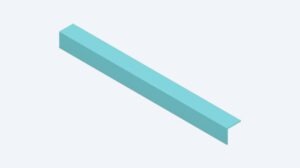
Bevelled GRP stair nosing profile
Item no. DD-ERPGR-TREPPENKANTE-30X75
Bevelled GRP angle profile with a gritted surface for retrofitting to stair edges indoors and outdoors. Clearly marks the step edge and prevents slipping.
- 30 × 75 mm, 3 mm thick, yellow (RAL 1003)
- Medium or coarse grit, others on request
- Fixed with PU adhesive or screws
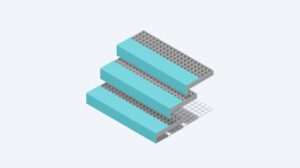
GRP stair tread cover R13
Item no. DD-ERPGR-STUFENABDECKUNG
Slip-resistant GRP stair tread cover for concrete, timber, stone or metal stairs. Provides lasting grip in wet, oily and frosty conditions.
- Slip resistance R13 V10 (DIN 51130)
- Profiles 30 × 150, 55 × 230, 55 × 300 and 55 × 345 mm
- Black or yellow (RAL 1003)
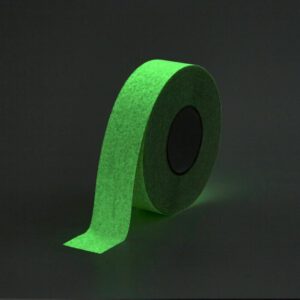
Photoluminescent anti-slip tape for stairs and walkways
Item no. DD-HSK-H3403X
Self-adhesive anti-slip tape with abrasive aluminium oxide grit in a photoluminescent resin. It provides additional marking of step edges and walkways if the lights fail; the afterglow effect requires sufficient prior illumination. Not suitable as mandatory escape route signage or as a substitute for a standard-compliant safety guidance system (DIN 67510, ISO 16069).
- Afterglow according to manufacturer: 30 mcd/m² after 2 min, 5 mcd/m² after 10 min
- Widths from 19 to 1,168 mm, roll length 18.3 m
- Application from 10 °C, service temperature from −30 to +70 °C
- Primer recommended on porous substrates, edge sealer at edges; slip resistance test values on request
Anti-slip stair nosing: frequently asked questions
Which material is best for outdoor stair nosing?
GRP is usually the best choice where de-icing salt and moisture are present, because it does not corrode. Aluminium and stainless steel with a slip-resistant surface are also suitable for outdoor use.
How wide should a stair nosing be?
The right width depends on the step, the type of use and the substrate. The profile should make the leading edge clearly visible and cover enough of the tread to provide grip where the foot lands.
Can non-slip stair nosing be fitted to timber stairs?
Yes – there are profiles for timber stairs that are screwed or bonded in place. Check beforehand that the wood is sound and dry.
Do nosing profiles also help people with visual impairments?
Yes – high-contrast profiles make the step edge clearly recognisable. This is particularly worthwhile in public buildings, hospitals and care homes.
What is the difference between a stair nosing profile and a stair trim profile?
A stair nosing profile protects the step edge, making it slip-resistant and clearly visible. A stair trim profile mainly serves to finish a floor covering neatly and usually has no tested slip resistance.
Which stair nosing profile is suitable for outdoor use?
For outdoor stairs we recommend GRP profiles with corundum grit: they are weather- and UV-resistant, do not rust and remain grippy in wet conditions, among fallen leaves or in frost.
Can stair nosing profiles be retrofitted to existing steps?
Yes. The profiles are bonded to the existing step and, depending on the substrate, additionally screw-fixed. There is no need to replace the stairs.
Related solutions and sectors
Further information: DGUV specialist area: Floors, ramps and stairs – publications (in German)
Find the right stair nosing for your stairs
We review step dimensions, substrate and requirements and recommend the right version – from a single staircase to fitting out an entire site.
Free expert advice
determine the right profile type, material and slip resistance class
Made to measure
cut to size for your step widths, also in special colours
Quick to retrofit
installation section by section without closing the stairwell
Long-term benefit
a durable, low-maintenance safety solution
Send us a no-obligation enquiry – we will find the right anti-slip stair nosing for your site.