Slip resistance classes, formats, surfaces and how to enquire. Around the clock.
How it works: from enquiry to delivery →Your input, photos and files are sent to Anthropic (Claude) and OpenAI (ChatGPT) in the USA to answer your question; according to the providers, API data is not used for training. Please do not enter personal or confidential data.Slip-resistant barefoot areas follow their own rules. The R9 to R13 ratings that apply to work areas where footwear is worn cannot be used here: bare, wet skin behaves completely differently on a surface than a shoe sole does. Instead, the relevant standard is the German DIN 51097 with classes A, B and C. Anyone who wants to make swimming pools, showers, changing rooms or washrooms safe needs to keep the two systems apart.
Slip resistance classes for wet barefoot areas
Testing is carried out on an inclined ramp with a barefoot test person, a wetted surface and a wetting agent. The angle reached determines the class.
Class A
from approx. 12° angle of inclination. For areas that are mostly walked on dry: barefoot corridors in dry zones, changing rooms, sauna anterooms.
Class B
from approx. 18°. For mostly wet surfaces: shower rooms, pool surrounds, foot baths, pool floors in shallow non-swimmer areas.
Class C
from approx. 24°. For particularly critical areas: sloping pool edges, pool entries, steps in the water, steeply inclined surfaces.
A Class C surface automatically meets the requirements of B and A as well. The reverse is not true – a Class A surface is not sufficient in a shower room.
Why wet areas are so accident-prone
A film of water between foot and floor acts like a lubricant – only an adequate surface texture breaks through it.
Soap, shower gel, shampoo and skin oils reduce friction further and build up in the surface texture.
People often move quickly and carelessly when barefoot, with nothing solid to hold on to – handrails are frequently missing.
Limescale and biofilm form unnoticed and can render even compliant surfaces ineffective.
Tiles with high water absorption and a glossy glaze look clean but are particularly hazardous when wet.
Solutions for existing wet room floors
New builds can be planned with compliant surfaces from the outset. For existing floors – by far the more common case – there are several ways to add slip resistance retrospectively.
Anti-slip flooring for barefoot areas
self-adhesive rolls and cut-to-size pieces with a soft, grit-free texture. They grip reliably without hurting the skin – coarse-grit industrial products are explicitly unsuitable here.
Clear anti-slip treatment
a chemical process that alters the microstructure of the tile surface and increases grip when wet, without changing its appearance.
Anti-slip coatings
systems applied over the whole surface with a finely tuned texture, suitable for larger continuous areas.
Non-slip mats and duckboards for wet areas
open, easy-to-clean structures that let water drain underneath – proven in shower corridors and changing rooms.
Anti-slip strips at critical points
targeted at steps, entries and ramps where the rest of the surface is adequate.
Typical applications
Indoor and outdoor swimming pools, hydrotherapy and hotel pools: pool surrounds, entries, starting areas
Shower rooms and changing rooms in workplaces, sports facilities and clubhouses
Sauna and spa areas, including relaxation zones and plunge pools
Washrooms in care homes, hospitals and sheltered housing
Accessible bathrooms and level-access showers in private homes
Campsites, leisure centres and public washroom facilities
Food businesses with wet cleaning where staff sometimes work barefoot or in sandals
Hygiene and cleaning – the other half of safety
Slip-resistant barefoot areas only stay safe if the surface texture remains open. In wet areas, the floor surface and the cleaning regime are therefore inseparable.
Avoid cleaning agents with film-forming ingredients – over time they clog the texture.
Remove limescale regularly; limescale gradually smooths the surface.
Clean mechanically, not just by mopping – use a brush or scrubber-dryer instead of a flat mop.
Include joints and edges, as this is where biofilm forms first.
Choose surfaces that can be fully bonded so that no water collects underneath.
Allow the floor to dry sufficiently after cleaning before reopening the area.
Standards and regulations at a glance
DIN 51097
German test method and classes A, B, C for wet barefoot areas.
DGUV Regel 107-001
German accident insurance rule on operating swimming pools, including requirements for floor surfaces and their maintenance.
DIN EN 13451
safety requirements for swimming pool equipment and fittings.
ASR A1.5
German workplace rule on floors, which also covers staff in pool and washroom areas.
DIN EN 16165:2023
overview of methods for determining slip resistance, including barefoot testing.
Selection guide
Is the area used barefoot, with shoes or both? With mixed use, both ratings need to be considered.
Is the surface permanently wet, occasionally wet or mostly dry?
How steep is the slope? Ramps and pool edges need a higher class.
Which cleaning methods and agents are used?
Does the appearance need to be preserved, for example in listed buildings or design-led interiors?
Should the solution be permanent or temporary, for example in a rented property?
Are there areas used by particularly vulnerable people, for example in care and therapy settings? See also our anti-slip solutions for older people.
Conclusion
In barefoot and wet areas, it is not the R rating that counts but the class under DIN 51097. Retrofitting existing floors calls for solutions that grip when wet and soapy, are kind to skin and can be cleaned hygienically. With the right combination of surface, treatment and cleaning regime, slip-resistant barefoot areas can be achieved reliably even after the event.
Suitable products
A selection from our range. We will gladly provide sizes, versions, prices and lead times on request.

PVC grid floor mat for barefoot areas
Item no. DD-TX-BODENMATTE
Open grid mat made from flexible, non-porous PVC profiles with base bars for swimming pools, showers, changing rooms, saunas and solariums. Water drains away in all directions, keeping the surface largely dry. Loose-lay, for indoor and outdoor use, custom-made in Germany.
- Slip resistance to DIN 51097, assessment group C
- Width 20 to 120 cm, length up to 6 m, 16 colours
- Through-coloured, free from lead and cadmium, UV-resistant
Rigid PVC mat for bathrooms and spas
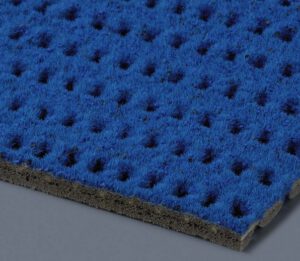
Item no. DD-FM-KOLIBRI
Rigid PVC matting for spa and bathing areas, public facilities, commercial and industrial premises and shipping, in several widths or made to measure.
- Rigid PVC
- Widths 60 / 80 / 100 cm or made to measure

Anti-slip tape for barefoot areas
Item no. DD-GRPF-3000011-TR
Anti-slip tape for barefoot areas such as showers, bathrooms, swimming pools and boats. Adheres to tiles, glass, enamel and acrylic.
- For bare feet
- Clear and four RAL colours
- Rolls 25/50/100 mm x 18 m
Wet-area mat with drainage holes
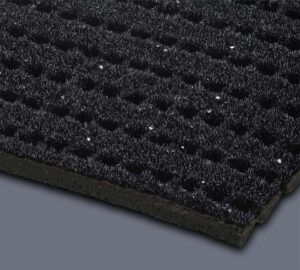
Item no. DD-MA-7789
Low-profile, closed-cell nitrile rubber mat for slippery wet areas such as changing rooms, showers, pool and spa surrounds, as well as operating theatres and preparation rooms. Drainage holes let water drain away; autoclavable and suitable for industrial washing.
- 6.35 mm nitrile rubber foam, grey or blue
- 60 × 90, 90 × 150 or 90 × 300 cm
- ASTM C1028-96: static coefficient of friction dry 0.99 / wet 0.82
Clear anti-slip coating for showers and bathrooms
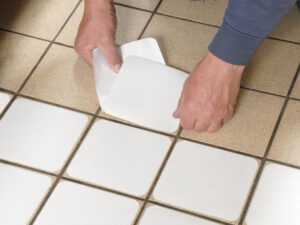
Item no. DD-GRPF-9000001
Clear two-component polyurethane coating for shower trays, baths and tiled floors that does not yellow. Can be removed again with a special remover.
- 2K polyurethane, clear
- For acrylic, enamel, tiles, glass
- Dirt- and water-repellent
FAQ: Slip-Resistant Barefoot Areas and Wet Areas
Which slip resistance class applies to showers and pool surrounds?
Usually Class B, as shower rooms and pool surrounds are mostly wet surfaces. Class C is the highest requirement, for example for sloping pool edges or steps into the water. The exact classification follows from the relevant regulations and your risk assessment.
Do R9–R13 ratings also apply to barefoot areas?
No – R9 to R13 describe slip resistance for areas where shoes are worn. Barefoot areas have their own classification into A, B and C under DIN 51097.
How does a slip-resistant wet area stay hygienic?
With easy-to-clean materials that let water drain away and a regular cleaning regime: remove soap residue and limescale, and avoid film-forming products.
Related solutions and sectors
Further reading: DGUV Information 207-006: Floor coverings for wet barefoot areas (in German)
Creating slip-resistant barefoot areas
Get free advice
determine the required class A, B or C
Choose the right solution
surface, treatment or coating, depending on the substrate
Keep it kind to skin
textures that grip barefoot without causing injury
Plan the cleaning regime
so that slip resistance is maintained long term
Enquire now – we will assess your wet area and recommend the right solution.