
Slip resistance classes, formats, surfaces and how to enquire. Around the clock.
How it works: from enquiry to delivery →Your input, photos and files are sent to Anthropic (Claude) and OpenAI (ChatGPT) in the USA to answer your question; according to the providers, API data is not used for training. Please do not enter personal or confidential data.A non-slip car park combines anti-slip coatings for driving lanes and ramps, stair nosings for stairwells and slip-resistant markings for walkways. Multi-storey and underground car parks are heavily used traffic areas: vehicles bring in rainwater, snow, road salt and oil, so smooth concrete and sloping ramps quickly become a slip hazard. That is why driving lanes, ramps, stairs and walkways need to be considered together.
For operating staff and winter maintenance crews: insulated, slip-resistant winter safety boots.
Operators, managing agents and facilities management teams are responsible for safe routes. Antirutschprofi supplies anti-slip coatings, tapes, nosing profiles and floor markings for retrofitting existing car parks. Many measures can be carried out section by section, so the car park can stay open. We help you find the right solution for every part of the site.
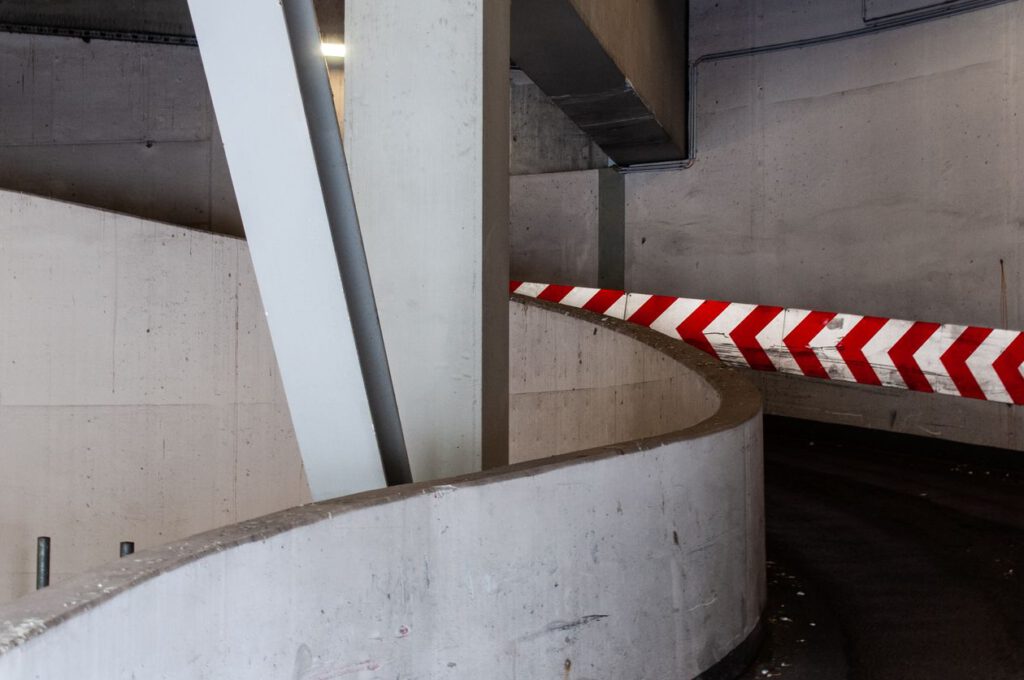
Typical slip hazards in multi-storey and underground car parks
Sloping entry and exit ramps, especially in wet or icy conditions
Concrete surfaces that are worn smooth or sealed
Entrance areas where water is tracked in from outside
Stairwells and escape stairs with worn step edges
Pedestrian routes between parking bays, pay stations and lifts
Areas with oil and fuel residues
Drainage channels and metal covers
The right solutions for a non-slip car park
Anti-slip coating for car parks
A coating with broadcast aggregate creates a grippy surface on concrete and asphalt. It is suitable for driving lanes, walkways and ramps. Before application, check the substrate and any existing coating. A compatibility test on a trial area is recommended. Find out more under anti-slip floor coatings.
Non-slip coating for car park ramps
Ramps are particularly at risk because gradient and moisture combine. On pedestrian sections of ramps, anti-slip strips laid across the direction of travel are a useful addition. They can be added section by section without coating the entire surface. For trafficked areas, coatings are usually the better choice.
Anti-slip stair nosing for underground car park stairs
Stairwells in underground car parks are often escape routes. Step edges should be clearly visible and offer good grip. Stair nosing profiles protect the edge and improve footing. Contrasting colours keep the steps visible even in poor lighting. In addition, anti-slip handrail grip ensures a secure hold.
Making pedestrian routes in the car park safe
Clearly marked walkways separate pedestrians from vehicles. Slip-resistant floor marking combines clear demarcation with grip, so the route stays safe to walk on even when wet. Pay particular attention to transitions to lifts, stairwells and pay stations.
Marking escape routes
Escape routes must remain recognisable in a power cut or smoke. Photoluminescent escape route marking supplements the existing emergency lighting. Agree the requirements for your site with the relevant specialists.
Winter solutions for access roads
Open parking decks and access roads are particularly critical in winter. For non-slip solutions for stairs and walkways in ice and snow, see winter safety for stairs and walkways.
Selection: what matters
Slip resistance
For car parks that count as workplaces, the German workplace rule ASR A1.5 “Floors” and its Annex 2 give guidance on the required R rating. For public traffic areas, the operator’s duty of care also applies. Clarify the requirements as part of your risk assessment.
Substrate
Concrete, asphalt, mastic asphalt and existing coatings all behave differently. Load-bearing capacity, residual moisture and contamination affect adhesion. Where the existing coating is unknown, a trial area makes sense.
Cleaning
Car parks are often cleaned by machine. The surface should provide grip without making cleaning unnecessarily difficult. Ask about versions resistant to oil or road salt; the relevant test certificates are available on request.
Fixing
Coatings are applied over the whole area. Strips and profiles are bonded or screwed in place. Trafficked areas place higher demands on adhesion than pedestrian-only walkways.
How your enquiry works
You describe the affected areas, substrates and approximate sizes – photos are welcome.
We propose suitable coatings, profiles or markings and clarify any open questions.
You receive a quotation and decide on the scope and specification.
Suitable products
A selection from our range. We will gladly provide sizes, versions, prices and lead times on request.
Entrance matting on a roll, herringbone pattern
Item no. DD-MA-4062
Large-format entrance matting on a roll with a two-level herringbone pattern for indoor and outdoor use. Laid loose or bonded; resists sunlight, moisture, bleach and de-icing salt.
- Roll 182 x 2042 cm
- SBR rubber backing with 20 % recycled content
- can be laid loose or bonded
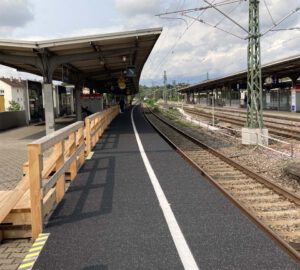
HDPE ground protection board
Item no. DD-CB-TT010001
Reusable ground protection board made from recycled HDPE for temporary roadways on construction sites, at events and in parking areas. Traction profile on one side, ribbed texture on the other; can be joined with PU or steel connectors.
- High load capacity according to the manufacturer (heavy goods traffic)
- 915 mm x 2.4 m, 10 mm, 20 kg
- Integrated carrying handles and connection holes
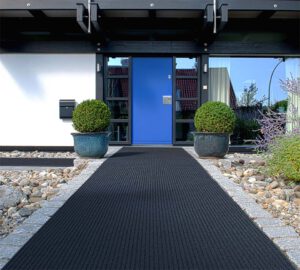
Entrance mat with rubber studs, diamond pattern
Item no. DD-MA-4208
Two-level entrance mat with rubber-reinforced nubs that traps water and dirt. In winter, for covered entrances and porches. Further patterns and border options are available on request.
- Indoor and outdoor, unaffected by de-icing salt
- PVC-free rubber backing, antistatic
- Optionally with magnetic retention system
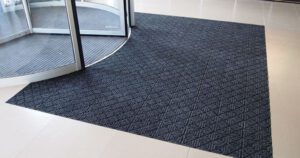
Modular entrance matting tiles
Item no. DD-MA-4061
Modular entrance matting tiles for large entrance areas indoors and outdoors. The two-level, rubber-reinforced pattern keeps dirt and moisture below shoe level; can be loose-laid or fixed with solvent-free adhesive or double-sided tape.
- Tile 45.72 × 45.72 cm, 12 per carton
- 6.35 mm, recycled PET surface, rubber backing
- Unaffected by salt and de-icers
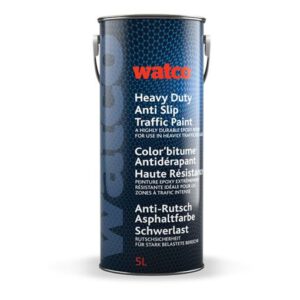
Slip-resistant asphalt coating for outdoor areas
Item no. DD-WTC-ASPHALT-2K
Two-component, solvent-based epoxy coating with mixed-in aluminium oxide aggregate for car parks, driveways, footpaths and vehicle areas on asphalt and concrete. Designed for more heavily trafficked areas than single-component asphalt paints; a decorative coating – it does not fill holes or cracks.
- 5 l pack for approx. 15–20 m² depending on surface roughness, usually one coat
- Asphalt at least 3 months old, new concrete at least 8 weeks (according to the data sheet); substrate dry
- Application from 15 °C air and 10 °C substrate temperature; cars and pallet trucks after approx. 24 h (20 °C); avoid contact with water for the first 7 days
- Not for mastic asphalt, wood, damp or damaged surfaces
- Slip resistance value and approval for forklift/HGV traffic on request
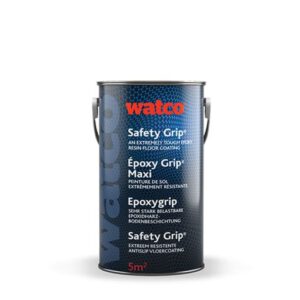
Epoxy anti-slip coating for ramps and industrial floors
Item no. DD-WTC-EPOXID-GROB
Three-component, high-build epoxy coating with coarse anti-slip aggregate for heavily used areas indoors and outdoors – ramps, loading bays, hazard zones and traffic routes with forklift traffic. One coat (approx. 320 µm) produces a heavily textured surface. For concrete, stone, rigid metals and well-adhering existing coatings at least three months old; not for asphalt and galvanised surfaces. Where an easier-to-clean surface matters more, the fine-textured epoxy floor coating is the better choice.
- 2.5 l pack for approx. 5 m², one coat
- Application from 15 °C air and 10 °C substrate temperature
- Foot traffic after approx. 16 h, forklift traffic after approx. 24 h (at 20 °C)
- Pendulum value 69 PTV (BS 7976-2) according to the technical data sheet; test certificate on request
- New concrete at least 8 weeks old, concrete moisture below 75% relative humidity; pot life approx. 30 min (20 °C); hazardous substance – observe the safety data sheet
Suitable safety footwear
For smooth, often damp concrete floors and ramps: S3 models with adaptive HRO rubber sole or grippy outdoor sole, with cold insulation for open decks.
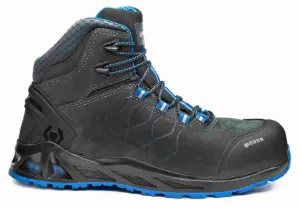
Safety shoe K-ROAD TOP (S3S)
item no. DD-BS-CA-B1001-0WB
- Protection class: S3S ESD HRO CI FO SR
- Sole: Adaptive dual-layer PU/HRO rubber sole
- Sizes: 36-48
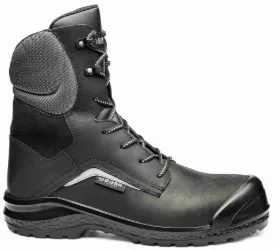
Safety shoe GREY TOP (S3)
item no. DD-BS-CA-B0835-0WA
- Protection class: S3 CI SRC
- Sole: Lightweight outdoor sole (4×4)
- Sizes: 36-50
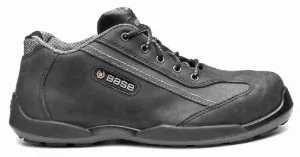
Safety shoe RALLY NEW (S3)
item no. DD-BS-CA-B0627-CWB
- Protection class: S3 SRC
- Sole: PU sole with TPU outsole
- Sizes: 36-47
FAQ: making a car park non-slip
Which anti-slip coating is suitable for car parks?
Coatings with broadcast aggregate for concrete and asphalt are usually the right choice. Which product suits depends on the substrate, the vehicle loads and the cleaning regime; a compatibility test on a trial area confirms adhesion.
Can a car park ramp be given a non-slip coating without closing it for long?
Often yes – working in sections or adding anti-slip strips to pedestrian areas reduces disruption. The closure time depends on the product, temperature and curing time; we agree the exact details with you for the specific product.
Which anti-slip surface is best for stairs in underground car parks?
Anti-slip stair nosings and anti-slip strips in a contrasting colour have proven most effective, as they improve grip and the visibility of the step edges. On badly worn steps, covering the whole tread can make sense.
How can pedestrian routes in a car park be made safe?
With marked, slip-resistant walkways, clearly visible transitions and grippy stairs. Slip-resistant floor marking does two jobs: it guides pedestrians and increases grip.
A non-slip car park protects users and staff and reduces liability risks for operators. Tell us about your site and we will show you how to make your car park non-slip.