
Anti-slip solutions for chemical plants have to do more than provide grip. On walkways, platforms and stairs, oils, solvents, acids, alkalis and water meet steel, concrete and gratings. Conventional coverings can be attacked by chemicals. In potentially explosive atmospheres, additional requirements apply.
We help you secure hazard points in chemical plants in a targeted way. GRP gratings, anti-slip sheets, coatings and rung covers can be adapted to different areas. On this page you will find typical problem zones, suitable product groups and advice on selection.
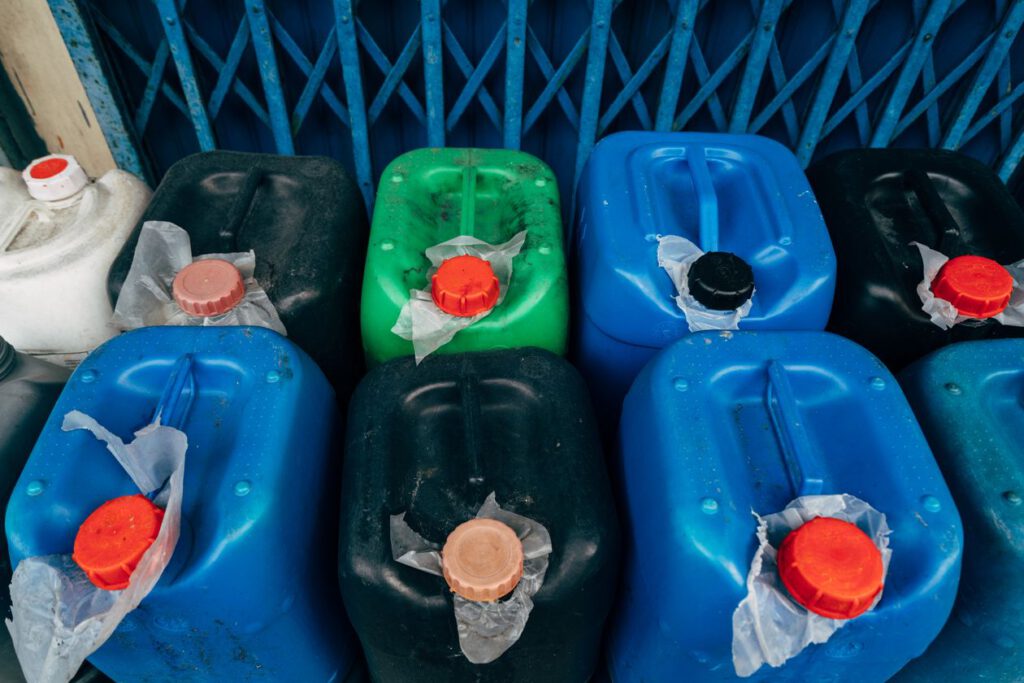
Typical hazard points in chemical plants
- Walkways and platforms at reactors, tanks and pipelines
- Gratings that become slippery due to drips and corrosion
- Stairs and fixed ladders to plant components
- Filling and transfer areas with spilled media
- Collection trays and tank farms with standing liquid
- Potentially explosive atmospheres with special requirements for materials
In chemical plants, maintenance and inspection also often take place away from the regular walkways. Employees climb onto platforms, open valves or take samples. In doing so, they often wear protective equipment that restricts vision and freedom of movement. This makes reliable grip all the more important at every point that is regularly accessed. So include rarely used access points and maintenance routes in your survey as well.
Anti-slip in chemical plants: suitable solutions
The following solutions can be used individually or in combination. Information on chemical resistance and suitability for hazardous areas applies to versions with corresponding test certificates, available on request.
Slip-resistant gratings in chemical plants
Slip-resistant gratings made of glass-reinforced plastic are an alternative to steel when corrosion is a problem. GRP does not rust and does not need to be painted. The gratings are available in various slip resistance classes and colours.
Dissipative GRP grating
In areas where electrostatic charging is to be avoided, a dissipative GRP grating may be required. We clarify whether a version is suitable for your area based on your requirements. Versions with corresponding test certificates are available on request.
Chemical-resistant anti-slip sheets made to measure
GRP anti-slip sheets can be screwed onto existing gratings, metal sheets or steps. For areas with chemical contact, please tell us the media and concentrations. We will then check which version is suitable. Cutting to size and custom-made products are possible.
Anti-slip covering for hazardous areas
Special requirements for materials apply in potentially explosive atmospheres. We offer anti-slip coverings and gratings for hazardous areas (Ex zones) as versions with corresponding test certificates on request. Please let us know the zone classification of your area.
Securing ladder rungs and stairs
Fixed ladders are common in chemical plants. Ladder rung covers improve grip on round or smooth rungs. For stairs, stair nosings are suitable.
Coatings for floors and collection areas
Slip-resistant floor coatings are suitable for concrete surfaces and transfer areas. For areas with chemical contact, we check suitability based on the media used.
Selection: what matters
Slip resistance: Annex 2 of ASR A1.5 (German Technical Rule for Workplaces on floors) assigns slip resistance ratings from R9 to R13 and, where applicable, a displacement volume to work areas. Testing is carried out in accordance with DIN EN 16165:2023 (the German edition of European standard EN 16165); older information refers to German standard DIN 51130. ASR A1.5 contains the basic requirements for floors in workplaces. Use this information as guidance for your risk assessment.
Substrate and media: Whether grating, chequer plate or concrete: the substrate determines the fixing method. Equally important are the media with which the covering comes into contact. Tell us the substances, concentrations and temperatures.
Cleaning: Clarify whether water, steam or cleaning chemicals are used. These agents must also be compatible with the material.
Fixing: Sheets are usually screwed or bonded. Special fasteners are used on gratings. Adhesives must be suitable for the medium and temperature.
How your enquiry works
- You describe the area, the substrate, the media and, where applicable, the Ex zone, ideally with photos and dimensions.
- We suggest suitable products and clarify which test certificates are required for your application.
- You receive an individual quote, including for cut-to-size and made-to-measure custom products.
Suitable products
A selection from our range. We will be happy to provide sizes, versions, prices and delivery times on request.
Anti-fatigue mat Hog Heaven Max
Item no. DD-MA-4424
Very thick industrial workplace mat with a nitrile rubber surface and closed-cell foam core. Designed for harsh environments with slag, oil, grease or chemicals.
- approx. 22 mm, nitrile rubber/foam core
- Black or yellow border
- ASTM C1028-96: static coefficient of friction dry 0.87 / wet 0.85
ESD workplace mat Infinity Bubble
Item no. DD-ERG-IN-ESD
Dissipative version of the Infinity Bubble for electrostatically protected areas. Combines ergonomic relief with resistance to ground according to IEC 61340-4-1 for electronics manufacturing and laboratories.
- ESD version, tested to IEC 61340-4-1
- Foamed PU, approx. 14.5 mm
- Cleanroom-compatible (EN ISO 14644-1)
Fire-retardant workplace mat Complete Bubble
Item no. DD-ERG-STF
Fire-retardant PU workplace mat with a studded profile that self-extinguishes when exposed to an open flame. Suitable for areas with fire protection requirements; Complete Smooth (SX) as a smooth version.
- Self-extinguishing, Cfl-s1 (EN 13501-1)
- Approx. 15 mm thick
- Edges do not curl up
Nitrile rubber workplace mat Nitrile
Item no. DD-ERG-EN
Black workplace mat made of non-porous nitrile rubber for oily environments. Does not warp or swell on contact with oil and withstands temperatures up to 90 °C.
- Nitrile rubber, oil-resistant
- 11 mm thick
- Operating range -40 to +90 °C
Conductive nitrile mat ESD
Item no. DD-ERG-ENC
Conductive nitrile rubber mat for ESD areas exposed to oil or chemicals. Combines dissipative properties according to EN 61340-5-1 with a robust, oil-resistant rubber surface.
- Conductive according to EN 61340-5-1
- Nitrile rubber, oil-resistant
- Cleanroom class ISO 3–9
Workplace mat Nitro for oily areas
Item no. DD-ERG-ENT
15 mm thick nitrile rubber mat with a grippy profile for very oily or wet workstations. Resistant to many acids and, briefly, to hot swarf up to 150 °C.
- Grip profile for oily/wet environments
- Nitrile rubber, 15 mm
- Operating range -40 to +90 °C
Anti-fatigue tile Fatigue-Step Nitrile
Item no. DD-CB-SS010007
Interlocking rubber tiles with nitrile content for wet, oily work areas. Drainage holes carry liquids away; according to the manufacturer, the tiles also withstand welding spatter and swarf.
- Rubber with 30% nitrile, 18 mm
- 22 mm drainage holes
- Slip test according to DIN 51130
Frequently asked questions about slip protection in chemical plants
Are chemical-resistant anti-slip sheets available made to measure?
Yes, anti-slip sheets can be made to measure. Chemical resistance depends on the medium, concentration and temperature. Versions with corresponding test certificates are available on request.
Why use slip-resistant GRP gratings in chemical plants?
GRP does not corrode like steel and is lightweight. This makes installation and maintenance easier. The slip-resistant surface improves grip in wet and oily conditions.
Which anti-slip covering is suitable for hazardous areas?
That depends on the zone classification and the requirements of your explosion protection concept. We offer versions with corresponding test certificates on request.
When does a dissipative GRP grating make sense?
When electrostatic charging is to be avoided, for example in areas with flammable substances. Whether this applies to your area follows from your explosion protection concept. We will advise you on the available versions.
Would you like to make walkways, platforms or stairs in your chemical plant safer? Tell us the area, substrate and media. We will check which anti-slip solution suits your plant.