
Do you want to upgrade an existing epoxy resin floor? Epoxy floors are seamless, chemical-resistant and easy to clean – but often slippery too. As soon as water, oil, coolant or dust gets onto the surface, slip resistance drops considerably. How an existing epoxy floor can be made slip-resistant retrospectively depends above all on adhesion, surface preparation and material compatibility.
Important: A new system will only adhere to an existing epoxy coating if the old coating is firmly bonded to the substrate, clean and abraded, and both materials are compatible. Before large-scale application, a trial area with adhesion and compatibility testing is recommended; on very smooth surfaces a special primer may be required.
Typical slip problems on epoxy floors
Smooth, glossy surface without aggregate broadcast
Oil, coolants and grease in workshops and production
Water and detergent residues after wet cleaning
Worn-away texture in the wheel tracks of forklifts and pallet trucks
Influence of water, oil, temperature, cleaning and loading
Water and oil
The choice depends on the type and amount of contamination and the slip resistance required; coarse textures can be advantageous, but are no substitute for evidence of suitability.
Cleaning
epoxy floors are chosen because they are easy to clean – an overly coarse anti-slip texture can cancel out this advantage.
Temperature
overcoats have minimum air and substrate temperatures and require curing time.
Loading
forklift traffic requires abrasion-resistant systems; mechanical solutions must be fixed so that they can be driven over.
Solutions compared
| Situation | Recommended solution | Advantages | Limitations | Suitable products |
|---|---|---|---|---|
| Smooth indoor epoxy floor, occasional moisture | Fine-textured epoxy overcoat | Remains easy to clean, seamless, wide choice of colours | Adhesion test and abrading required; indoor use only; too fine for oil and ramps | DD-WTC-EPOXID-FEIN |
| Oil, ramps, hazard zones, forklifts | Coarse epoxy anti-slip coating | Heavily textured, approved for forklift traffic according to the manufacturer | Harder to clean; existing coating must be firmly bonded | DD-WTC-EPOXID-GROB |
| Walkways, stair landings, no downtime possible | GRP anti-slip sheets | Mechanically fixed, usable without curing time; removable again when screwed | Fixing through the coating; mind the edges | DD-GRPF-8000205-YE-M |
| Individual hazard points, markings | Anti-slip tape | Quick and inexpensive, also as a warning marking | Check adhesion on the smooth coating; cleaning can lift the edges | DD-GRPF-3000005-YE, DD-GRPF-3000087-BY |
| Standing workstation with oil | Oil-resistant workstation mat | Slip resistance plus ergonomics, no floor works | Local only; mat must be cleaned | DD-ERG-EN |
Suitable products
Coatings are supplied as materials only; we do not offer application ourselves. An overview of further systems can be found under Anti-slip floor coatings.
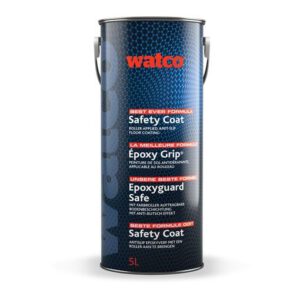
Slip-resistant epoxy floor coating with fine texture
Item no. DD-WTC-EPOXID-FEIN
Two-component, water-based epoxy floor coating with fine, rounded aggregate for workshops, warehouses and production areas indoors. The finely textured, slightly glossy surface remains easy to clean; for ramps and heavily oil-contaminated areas, the coarse epoxy anti-slip coating is the better choice. A coarse-grit version for hazard zones is available.
- 5 l pack: approx. 30 m² per coat, approx. 15 m² finished area with two coats
- Application from 15 °C air and 10 °C substrate temperature; indoor use only
- Forklift traffic after approx. 24 h (at 20 °C), chemical resistance after 7 days
- Pendulum value 54.6 PTV (BS 7976-2) according to the data sheet; reaction to fire Bfl-s1 according to manufacturer information, classification report on request
- For concrete, wood and firmly adhering existing coatings (very smooth surfaces may require a special primer); not for bare metal and self-levelling compounds
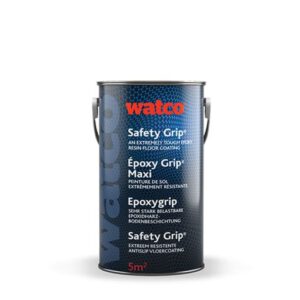
Epoxy anti-slip coating for ramps and industrial floors
Item no. DD-WTC-EPOXID-GROB
Three-component, high-build epoxy coating with coarse anti-slip aggregate for heavily used areas indoors and outdoors – ramps, loading bays, hazard zones and traffic routes with forklift traffic. One coat (approx. 320 µm) produces a heavily textured surface. For concrete, stone, rigid metals and well-adhering existing coatings at least three months old; not for asphalt and galvanised surfaces. Where an easier-to-clean surface matters more, the fine-textured epoxy floor coating is the better choice.
- 2.5 l pack for approx. 5 m², one coat
- Application from 15 °C air and 10 °C substrate temperature
- Foot traffic after approx. 16 h, forklift traffic after approx. 24 h (at 20 °C)
- Pendulum value 69 PTV (BS 7976-2) according to the technical data sheet; test certificate on request
- New concrete at least 8 weeks old, concrete moisture below 75% relative humidity; pot life approx. 30 min (20 °C); hazardous substance – observe the safety data sheet
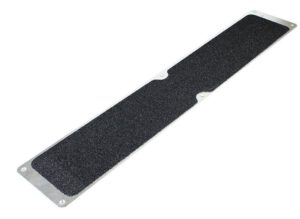
Lightweight GRP anti-slip sheet
Item no. DD-GRPF-8000205-YE-M
Lightweight anti-slip sheet in glass-reinforced polyester with aluminium oxide grit, for covering floors, ramps, walkways and chequer plate indoors and outdoors.
- GRP with aluminium oxide grit
- Non-conductive, will not splinter or crack

Standard anti-slip tape
Item no. DD-GRPF-3000005-YE
General-purpose anti-slip tape in many RAL colours for stairs, platforms and floor areas. Quick to apply, easy to clean and also suitable for marking.
- Rolls 25/50/100 mm x 18 m
- Numerous RAL colours
- Easy to clean
Coarse anti-slip tape, black/yellow
Item no. DD-GRPF-3000087-BY
Coarse-grit non-slip tape for heavily used steps, landings and surfaces. The black and yellow version doubles as a hazard marking.
- Rolls 25/50/100 mm × 18 m
- Can be cut to size
- Non-conductive

Nitrile rubber workstation mat, oil-resistant
Item no. DD-ERG-EN
Black workstation mat made of non-porous nitrile rubber for oily environments. Does not curl or swell on contact with oil and withstands temperatures up to 90 °C.
- Nitrile rubber, oil-resistant
- 11 mm thick
- Operating range -40 to +90 °C
Limitations and unsuitable applications
Loose, blistered or undermined existing coatings must be removed first.
Unknown existing coating: check compatibility on a trial area and, if in doubt, consult a specialist contractor.
Floor coverings containing plasticisers, self-levelling compounds and permanently wet areas are not suitable for every overcoat.
No blanket suitability for “all epoxy floors” – the manufacturer’s specifications for the chosen system are decisive.
FAQs: making an epoxy floor non-slip
Can an epoxy floor be made non-slip retrospectively?
Yes, provided the existing coating is firmly bonded. It is cleaned, degreased and abraded, followed by a slip-resistant overcoat. Alternatively, GRP sheets, tapes or mats can be used without any coating work.
Does the old coating have to be removed?
Only if it is loose, flaking or incompatible. Firmly bonded existing coatings are usually abraded and can be overcoated – a trial area provides certainty.
Fine or coarse texture?
Fine-textured surfaces remain easier to clean and are sufficient for occasional moisture. With oil, ramps or hazard zones a coarse texture is usually advantageous; the risk assessment and evidence of suitability are decisive.
How soon can the floor be used again?
For the epoxy coatings listed here, the manufacturer states approx. 24 hours at 20 °C until release for heavy traffic; full chemical resistance after around 7 days. At lower temperatures the data sheets apply. Mechanically fixed solutions do not require any curing time.
Enquiry for your project
To prepare a suitable quotation, we need the following information:
Substrate and condition
Area in m² or number and dimensions of steps
Indoors or outdoors
Exposure to water, oil or chemicals
Pedestrian, pallet truck or forklift traffic
Required slip resistance
Site or delivery location
All prices on request. Send an enquiry now.